Nagasaki Was More than a Window to the West: Routes, Faith and Control
Introduction
Japan's overseas relationships long preceded Nagasaki's rise as a trading port.
Maritime exchange reaches back to prehistory. Boats connected islands during the Jomon period, and Tsushima has traces of interaction with the Korean Peninsula and mainland China from about 7,000 years ago. In antiquity, writing, Buddhism, Confucianism and other continental culture reached Japan through multiple routes linking China and Korea.
Nagasaki's role grew in the sixteenth century as European powers entered Asia. Portuguese merchants and Catholic missionaries arrived first; the Dutch came later. Chinese merchants also supported the port's formation and trade. Relations with Korea, meanwhile, chiefly passed through Tsushima.
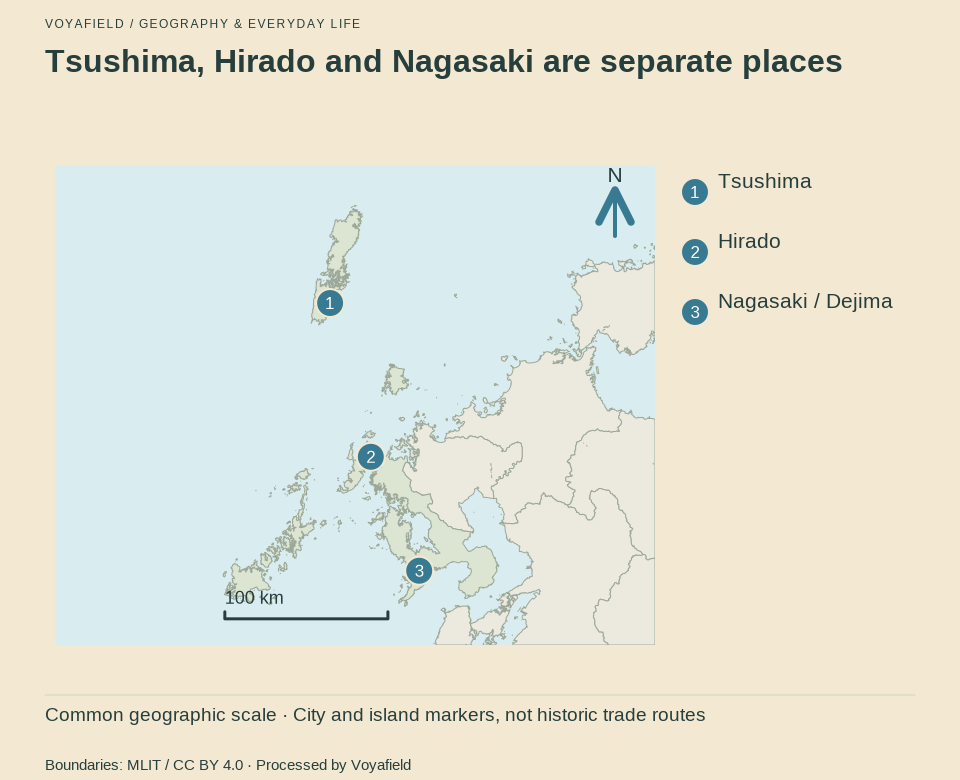
Sites within the same present prefecture connected different partners under different systems and at different times.
1. Before Dejima
After Francis Xavier arrived in 1549, Catholic missions expanded and ports linked with Portuguese trade developed across Kyushu. Portuguese ships entered Nagasaki in Omura territory in 1571, and the town took shape.
Toyotomi Hideyoshi did not immediately end trade, but ordered missionaries expelled in 1587 and placed Nagasaki under direct control in 1588. In 1597, 26 missionaries and believers were executed at Nishizaka.
Port growth, acceptance of Christianity and religious control developed in the same era. Commerce and faith were subject to government intervention before the Dutch post moved to Dejima.
2. From Hirado to Dejima: sakoku was not complete closure
The Dutch East India Company established its Hirado trading post in 1609. Dutch trade began in a port and castle town in northwestern Kyushu.
Against a background of religious concern, the Tokugawa shogunate, the government of the Edo period (1603–1868), gradually strengthened controls on overseas travel, missionaries, foreign ships and transactions, narrowing permitted partners and ports. Later called sakoku, this system did not sever every overseas connection.
Dejima, completed in 1636, initially separated Portuguese residents from the town. Portuguese ships were prohibited in 1639; the Dutch post moved from Hirado in 1641. European trade continued with restricted partners, places and conditions.
Chinese trade also concentrated at Nagasaki. Merchants initially stayed in town and traded through Japanese merchants and interpreters. In 1689, the Chinese compound was completed partly to combat smuggling, controlling residence and movement. Dejima and this compound were separate arrangements for different partners at one port.
3. Tsushima's work across the sea
While Nagasaki received Chinese ships and the Dutch post, Tsushima's So family handled relations with Korea. Negotiation, interpretation, returning castaways, preparations for diplomatic missions and trade continued along the Tsushima-Busan route rather than through Nagasaki Port.
Twelve Korean diplomatic missions visited Japan between 1607 and 1811. Routes crossed from Busan through Tsushima, Iki, Shimonoseki and the Seto Inland Sea toward Edo. In 1811, financial circumstances in both countries helped lead to reception on Tsushima rather than travel onward to Edo. Tsushima was a place of negotiation and reception as well as passage.
4. Churches appear in the later part of the story
Christian prohibitions banned propagation and belief, requiring missionaries to leave and believers to change faith. Tokugawa prohibitions extended to directly controlled lands in 1612 and nationwide in 1614.
Removing Portuguese ships and missionaries did not simultaneously erase established belief. Communities under prohibition passed on prayers, calendars and roles while participating in Buddhist temple affiliation and relationships with local shrines.
Some people moved from Sotome, the coast northwest of Nagasaki City, to Kuroshima, Goto and elsewhere. Agreements between lords, land clearing, livelihoods and faith overlapped in migration.
Church buildings are often the most visible sites today, but many were built after prohibition ended. Homes, fields, cemeteries, coastal settlements and daily life sustained the hidden period.
Nagasaki opened for foreign trade in 1859, and Oura Cathedral was built in the foreign settlement. In 1865, hidden Christians from Urakami disclosed their faith to Father Petitjean, the event known as the “Discovery of Christians.”
This did not lead straight to freedom. Urakami believers were subsequently deported, and prohibition notices were removed only in 1873. Some rejoined Catholicism afterward; others continued practices formed during concealment.
5. Today's sites do not display one common period
Hirado's trading-post site points to the early seventeenth century before concentration at Dejima. Dejima and the Chinese compound show distinct controls within Nagasaki Port. Tsushima's records and diplomatic memories lead to Korea. Sotome and island settlements, graves and churches encompass a longer span from prohibition to its aftermath.
The culture often grouped as Japanese, Chinese and Dutch contains exchanges conducted under different periods and institutions.
6. Different relationships across the prefecture
Nagasaki Port, where Chinese and Dutch trade was controlled; Hirado, before the trading post moved; and Tsushima, where negotiations with Korea were handled, did not perform the same role in one common period. Settlements in Sotome and Goto preserve evidence of life under prohibition that differs from the evidence left by port trading facilities.
The Nagasaki geography overview explains their positions and transport connections.
References
- 荒野泰典・石井正敏・村井章介編『日本の対外関係5 地球的世界の成立』吉川弘文館、2013年、ISBN 978-4-642-01705-3。
- 荒野泰典・石井正敏・村井章介編『日本の対外関係6 近世的世界の成熟』吉川弘文館、2010年、ISBN 978-4-642-01706-0。
- 瀬野精一郎・新川登亀男・佐伯弘次・五野井隆史・小宮木代良『長崎県の歴史』第2版、山川出版社、2012年、ISBN 978-4-634-32421-3。
- 長崎市「歴史年表 室町時代・安土桃山時代・江戸時代」:https://www.city.nagasaki.lg.jp/page/2255.html
- 長崎市「唐人屋敷の歴史」:https://www.city.nagasaki.lg.jp/page/2242.html
- 平戸市「平戸和蘭商館跡」:https://www.city.hirado.nagasaki.jp/kurashi/culture/bunka/hiradoisan/hi06.html
- 対馬博物館「倭館――中近世 日朝交流の最前線」:https://tsushimamuseum.jp/exhibition/2155/
- 外務省外交史料館「外交史料 Q&A その他(朝鮮通信使)」:https://www.mofa.go.jp/mofaj/annai/honsho/shiryo/qa/sonota_02.html
- 文化庁「大浦天主堂境内」国指定文化財等データベース:https://kunishitei.bunka.go.jp/heritage/detail/401/00003763
- ICOMOS, “Hidden Christian Sites in the Nagasaki Region”:https://whc.unesco.org/document/168689
- 国立公文書館「易地聘使録」。1811年の対馬での応接(2026年10月2日確認)。
- 九州国立博物館「対馬―遺宝にみる交流の足跡―」概要・第1章。本文