Uji Tea Fields: Covering Materials and the Work of Cultivation
Introduction
A cover goes over a tea field. That one job involves gathering materials, putting up supports, regulating light and taking the cover down after harvest. Looking at the field only while its leaves are growing leaves much of that preparation unseen.
The Uji tea region includes shaded fields and open rows on slopes. The shape of a field and the work it needs depend on which tea is grown and which machines and materials are used.
1. Is Uji tea made only in Uji City?
The Kyoto tea industry association's 2004 definition covers tea grown in Kyoto, Nara, Shiga or Mie and finished within Kyoto Prefecture by businesses based there, with priority for Kyoto-grown material. This is an industry definition, not the same as a national certification system.
The association describes wholesalers sorting partially processed tea, blending it and dispatching it. Aracha is tea after its initial processing, with stems and fine particles mixed among the leaves. Finishing separates these components and blends different teas. Gogumi means that blending.
Growing and finishing need not occur in the same place. For an individual product's origins, check raw-material sources and processing information as well as the name Uji tea.
2. Growing tea under shade
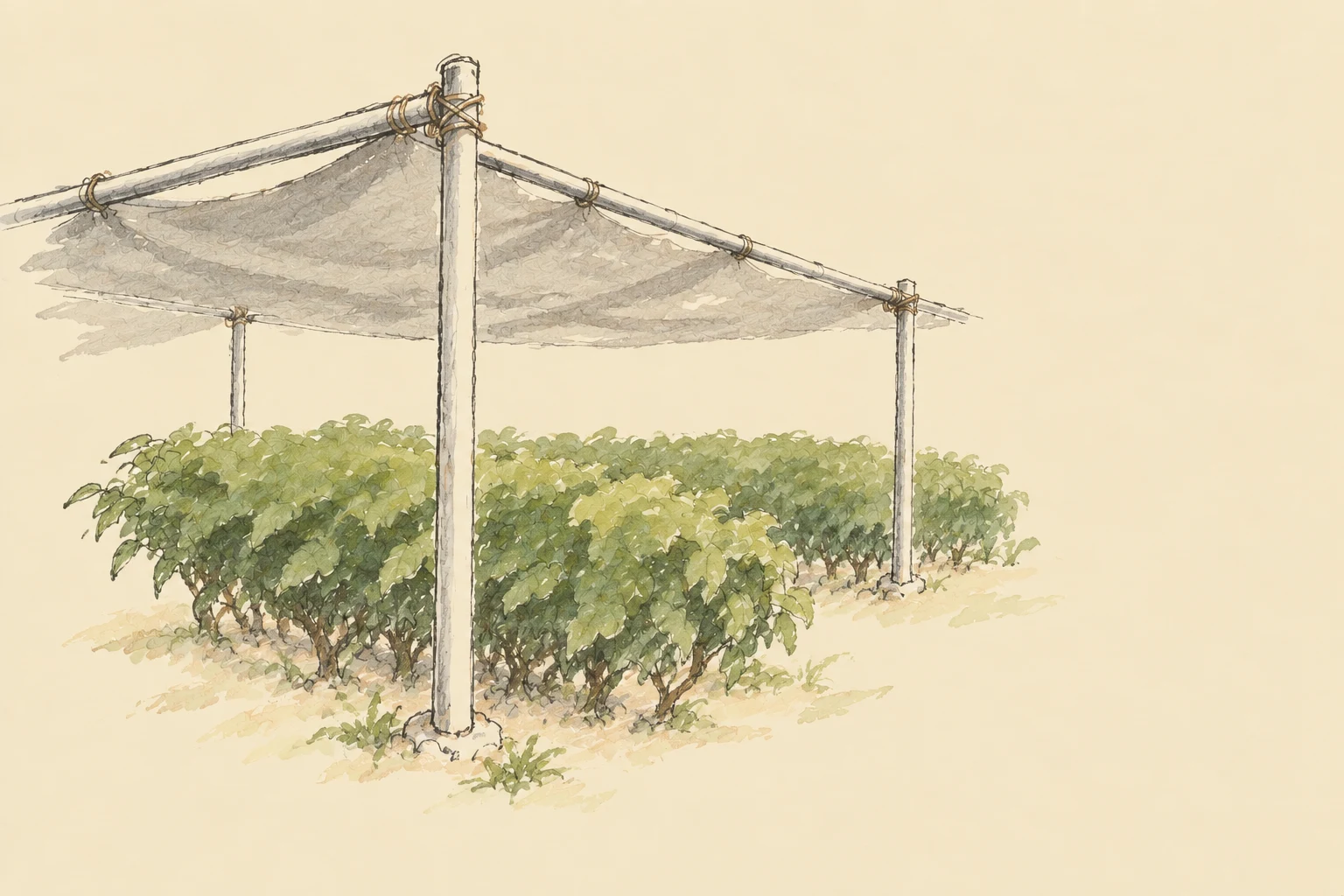
Shade cultivation blocks light for a period while new shoots grow. Tencha, gyokuro and kabusecha are made this way; tencha is the tea used to make matcha. Covers may rest on frames or lie directly over the bushes. A black cover alone does not reveal which tea is being grown or every step used to grow it.
Uji City's cultural history of tea describes covered cultivation using trellises through missionary accounts from the late sixteenth century. The materials and procedures were not identical to those used today, but covering tea fields has a long history.
3. How new materials changed the work
Steel-pipe frames and synthetic covers have contributed to labor savings. Some methods combine steel supports with reed screens and straw above, rather than replacing every material at once.
The prefecture's 2026 centenary history of its tea research institute dates labor-saving research to 1951. A single synthetic layer on a fixed frame developed in 1963 raised temperatures beneath it, accelerating shoot growth and hardening. Work to preserve quality led to two-layer covering technology in 1971.
Trials combining reed screens and recycled paper in 2000-2004 produced tea of broadly comparable quality, but covers tore readily in wind or impacts. A method rolling straw mats to reduce covering and removal time was presented in 2020, though costs remained high. These are trial records, not proof of adoption or improved finances at every farm.
Material changes affect temperature, picking time, durability and spending as well as work hours. A lightweight cover that tears easily brings replacement work and costs of its own.
4. Hillside fields and mechanization
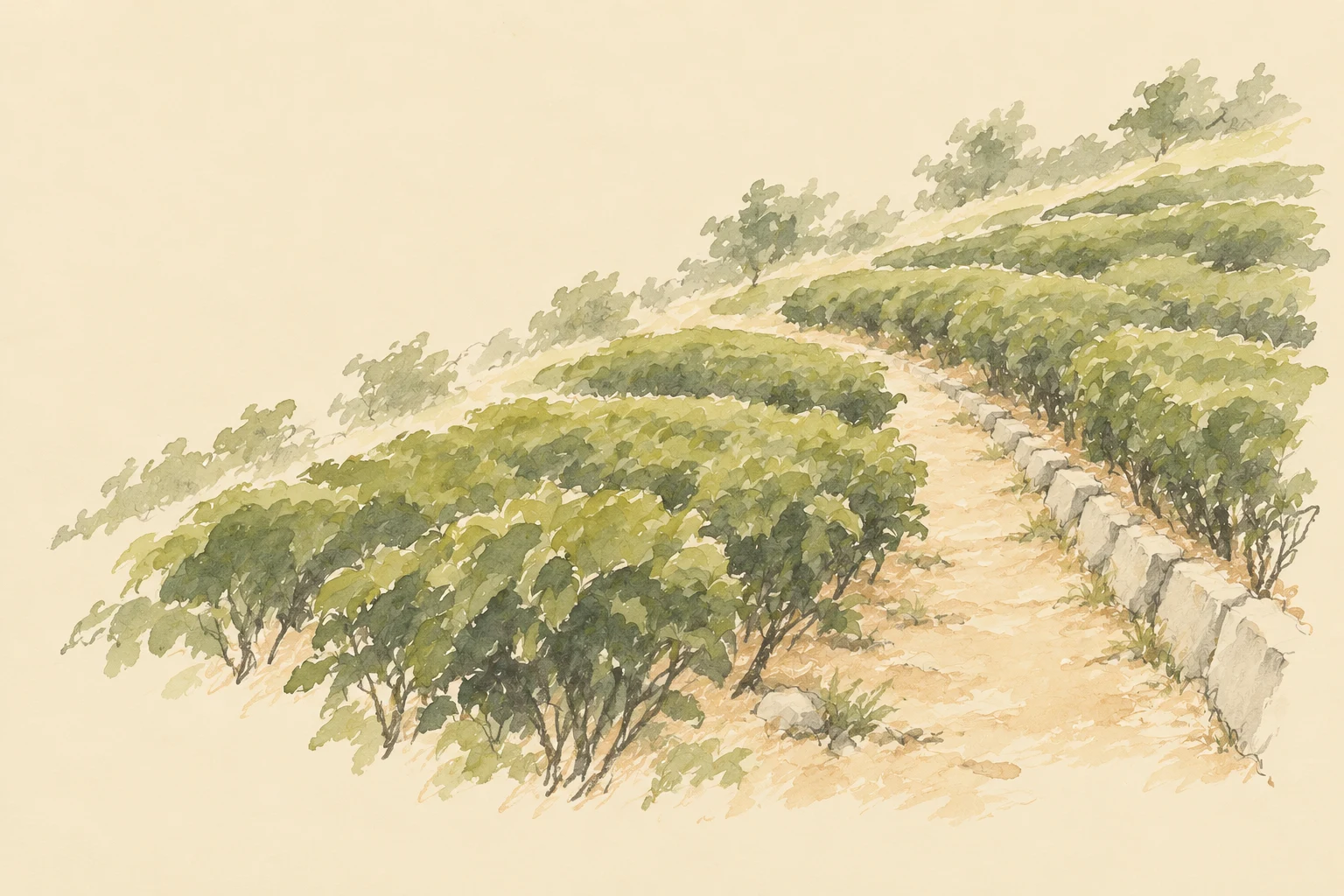
Ujitawara and Wazuka have hillside fields, while Joyo and Kyotanabe along the Kizu have shaded fields.
In Minamiyamashiro, demand for export sencha in the early Meiji period encouraged slope clearing, with tea from ridges down slopes and houses and rice fields below. Large-scale earthworks and mechanized group plantations were added in 1965–1974.
Rows running up and down a slope are also related to the use of powered or ride-on picking machines. Their direction reflects how people and machinery move when harvesting tea.
5. When the appearance of a field changes
Covers are removed after picking, so shaded fields change with the season. A field seen at one point in the year cannot show all the work involved in preparing, fitting and removing its covering.
Uji tea production involves growing leaves, supplying materials for covered fields and finishing partially processed tea. These stages take place across a production region that extends beyond the fields themselves.
References
- 京都府『茶業研究所100年史』2026年2月、第III部2「栽培技術、土壌肥料、気象災害対策技術、病害虫防除技術等」。京都府による公開本文
- 京都府茶業会議所「宇治茶Q&A」。本文・所在
- 京都府茶業研究所「被覆栽培(覆い下栽培)」2017年10月3日更新。京都府による解説
- 京都府『「宇治茶の文化的景観」世界遺産暫定一覧表記載資産候補に係る提案書』2017年改訂、pp.10–11。京都府の提案書・公開部分
- 京都府教育委員会文化財保護課「南山城村の宇治茶生産景観」2022年9月12日。本文・所在
- 宇治市歴史資料館編『宇治茶の文化史』宇治市教育委員会〈宇治文庫4〉、1993年。CiNii Books BN09176566。 pp.44–61。NDLデジタル本文
- 京都府茶業百年史編纂委員会編『京都府茶業百年史』京都府茶業会議所、1994年。CiNii Books BN12800553。 pp.207–212・228–235・237。NDLデジタル本文
- 金田章裕・石川義孝編『日本の地誌8 近畿圏』朝倉書店、2006年。ISBN 9784254167689。