Pumps Supporting Niigata's Rice Fields: Water In and Out of Kamedago
Introduction
Water gathering in Toyanogata Lagoon cannot simply flow into the nearby Shinano River: the lagoon's surface is lower. The Oyamatsu pumping station sends it into the river.
Kamedago is low ground in central Niigata City, enclosed by coastal dunes and the embankments of the Shinano, Agano and Koagano. Rain and agricultural drainage collect in Toyanogata. Removing that water sustains both fields and surrounding urban land.
1. A nearby river does not guarantee natural drainage
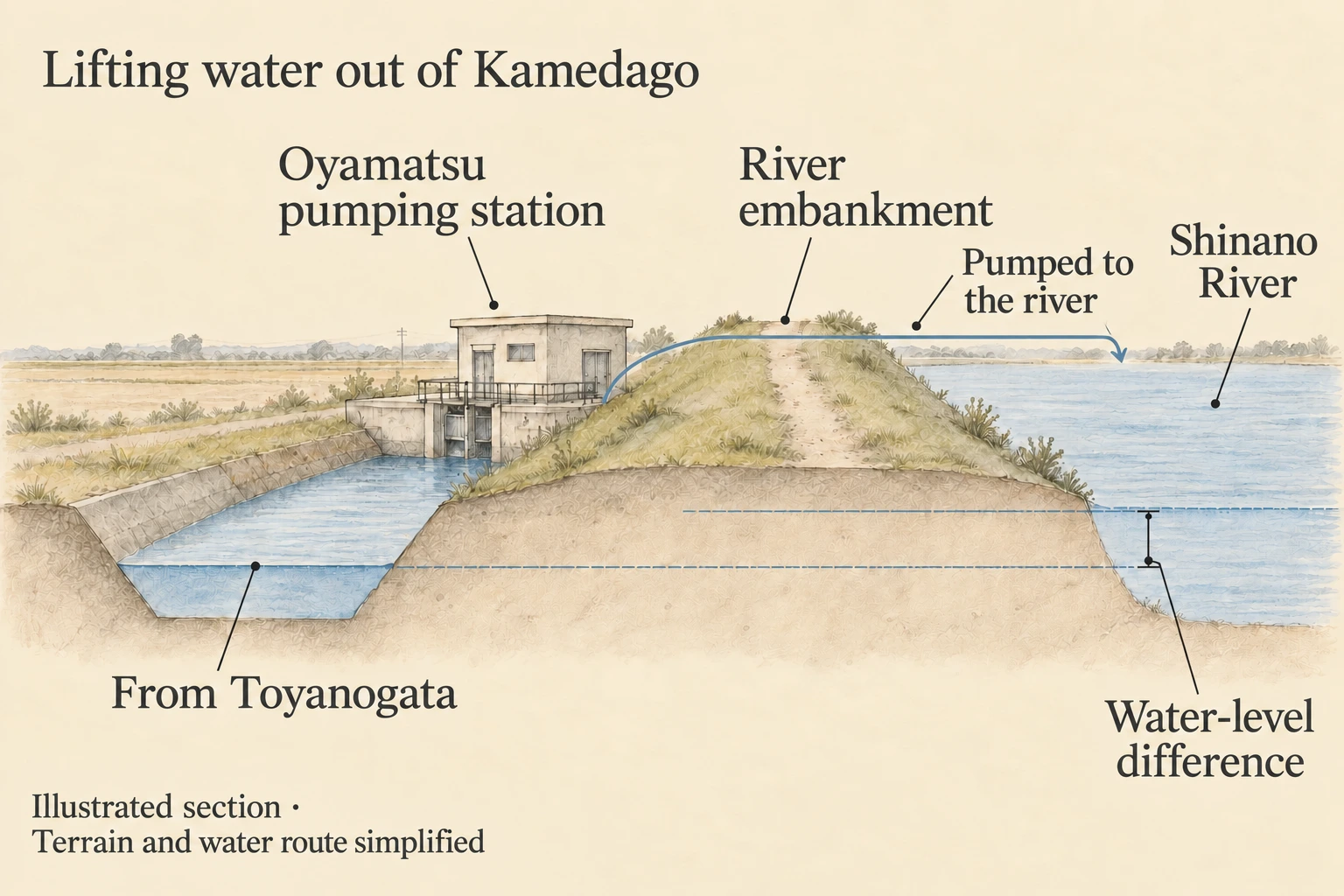
Oyamatsu’s pumps overcome the difference in water level between Toyanogata and the Shinano. The prefecture’s facility account describes operation with round-the-clock water-level monitoring.
Irrigation water, meanwhile, comes from the Agano, Shinano and Koagano through pumping stations and channels. Making fields drainable does not mean keeping them dry all year, but enabling water to be added and removed as needed.
The Koaga sluice protects against Agano flooding while passing needed water into the Koagano. The neighboring Manganji lock serves boats.
2. Facilities supporting farmland and urban areas
After the 1964 Niigata earthquake, the Oyamatsu channel and pumping station were built in 1968 to collect regional water in Toyanogata and discharge it to the Shinano.
As urbanization proceeded, agricultural drainage also supported residential and commercial areas. The adjacent Toyanogata pumping station is a separate facility, developed to increase discharge to the Shinano after the heavy-rain damage of 1998.
The prefecture lists Oyamatsu as nationally owned and managed under delegation to the prefecture. The Kamedago Land Improvement District also manages and repairs local irrigation pumps and channels. Maintenance extends beyond the large pumps to the equipment along water's journey into and out of fields.
3. Holding rain temporarily in fields
In Niitsugo, separate from Kamedago, the effects of “rice-field dams” regulating discharge at field outlets have been examined. An analysis presented in 2022 modeled widespread installation after planned improvements to field layouts and channels, testing reductions in flows entering channels at peak rainfall. It was not a measurement of an effect already achieved across the region.
Rice-field dams slow the release of rainwater into channels; pumping stations discharge water from the area. Retention requires suitable field banks and outlets, with operation agreed with farmers so crops are not harmed.
Kamedago's rice fields depend on facilities and management that bring water in, remove it at appropriate times and send it out of the region. Urban areas sharing the same drainage route depend on that system too.
References
- 新潟県「【新潟】亀田郷を水から守る」、2019年3月29日更新。地形と排水
- 新潟県「親松排水機場」、2019年6月29日更新。水位差・監視・運転
- 新潟県「国営造成県管理施設の概要」、2025年1月7日更新。灌漑と排水、所有と管理
- 農林水産省「水が伝える、豊かな農村空間」『aff』2025年7月号。亀田郷の用排水と管理の仕事
- 国土交通省北陸地方整備局阿賀野川河川事務所「満願寺閘門と小阿賀樋門」。水の流入調整と舟運の区別
- 国土交通省北陸地方整備局信濃川下流河川事務所「鳥屋野潟排水機場」。1998年水害後の排水計画
- 農林水産省北陸農政局信濃川水系土地改良調査管理事務所『信調だより』103号、2022年2月、3–5頁。新津郷の田んぼダム解析は5頁
- 亀田郷土地改良区『亀田郷の昔語り』亀田郷土地改良区、1998年10月、572頁。NDL書誌 000002738979。
- 亀田郷土地改良区『亀田郷土地改良誌 '87』亀田郷土地改良区、1990年。従来の発行案内。
- 斎藤功・石井英也・岩田修二編『日本の地誌6 首都圏II』朝倉書店、2009年。ISBN 9784254167665。 CiNii Books
- 西田美昭・久保安夫編著『西山光一日記 1925–1950年―新潟県一小作農の記録』東京大学出版会、1991年。ISBN 9784130260503:東京大学出版会