Niigata Port: A River Carrying Rice and the Work of Removing Sediment
Introduction
Niigata was selected as a treaty port in 1858. Yet even after opening in January 1869, foreign ships with a deep draft—the distance from the waterline to the bottom of the hull—struggled to enter the Shinano's mouth. Shallow water, waves and sediment arriving from upstream obstructed the entrance and destabilized the channel.
The Shinano carried inland rice toward the sea, but also sediment that made the port shallower. Jetties and dredging were necessary to handle cargo and admit ships at the river mouth.
1. Niigata and Nuttari ports
Early in the Edo period, the river mouth contained Niigata port in Nagaoka domain and Nuttari port in Shibata domain. Domains were territories governed by regional lords, so the two ports answered to different authorities. As channels shifted, port towns moved and faced each other across the Shinano. In a dispute over ship calls, the shogunate upheld Niigata's claims; Nuttari is described as having lost influence.
The western coastal route established in 1672 connected Niigata with Osaka via Shimonoseki and the Seto Inland Sea, carrying rice and soybeans. An earlier record appears in the Engishiki, a compilation of administrative regulations completed in 927, which lists Kanbara-tsu as a port of Echigo province.
Smuggling was discovered at Niigata in 1835 and 1840. In 1843, the shogunate transferred the town from Nagaoka domain to direct control, citing defense against foreign ships and suppression of smuggling. Port operation involved supervision of trade as well as conditions for ships to call.
2. Large ships still struggled after opening
The actual opening was in the eleventh month of Meiji 1, January 1869 in the Western calendar. Deep-draft ships stayed offshore and transferred goods through smaller boats.
The British consulate closed in 1879. Designation as an open port and conditions making it usable for trading ships were different achievements.
3. Jetties and dredging maintain the channel
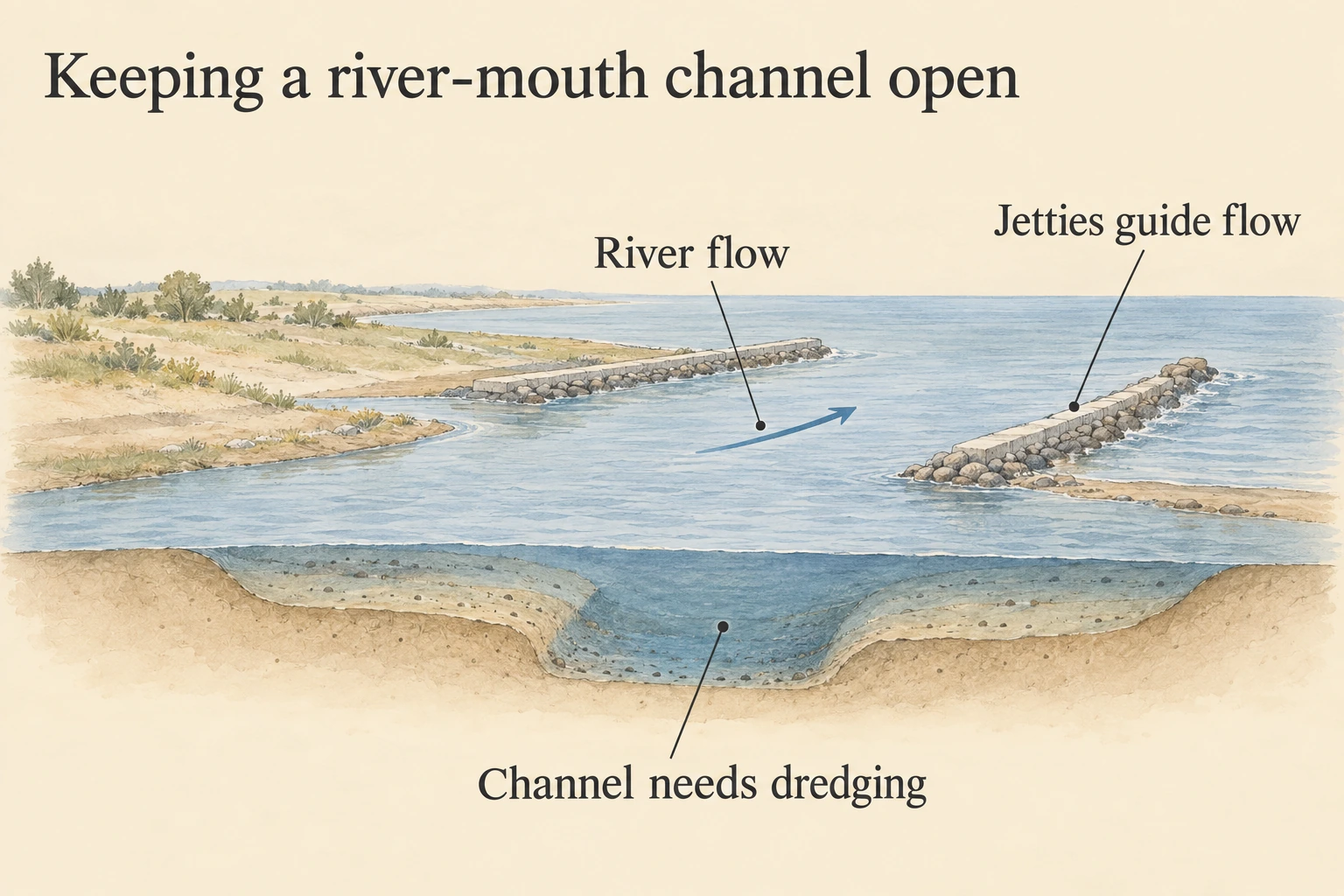
Structures guiding the river-mouth channel and dredging to remove sediment have been used together to maintain shipping access.
Structures do not stop sediment arriving. Measuring depths and excavating places that have become shallow remain necessary.
The Niigata port and airport development office's fiscal 2026 works also include channel and anchorage dredging.
4. Follow the river upstream from its mouth
Around Minatopia, the Niigata City History Museum, the Shinano can be seen alongside the former customs house. Old maps also show riverside storehouses and boat inlets. Today's embankment should not be mistaken for an unchanged Edo-period landing place.
Niigata's history includes both Sea of Japan routes and Shinano river transport. Rivers collecting rice, warehouses storing it, transfer points for seagoing ships and works keeping channels open together connected inland areas with the sea.
References
- 新潟市「新潟港の歴史」、2021年4月21日更新。公式ページ。
- 新潟市役所コールセンター「新潟みなとの歴史について知りたい」、2022年1月13日更新。公式ページ。
- 国土交通省北陸地方整備局 新潟港湾・空港整備事務所「新潟西港の整備」。公式ページ。
- 新潟市編『新潟湊の繁栄』新潟歴史双書1、新潟市、1998年。
- 新潟市編『新潟港のあゆみ』新潟歴史双書7、新潟市、2003年。
- 斎藤功・石井英也・岩田修二編『日本の地誌6 首都圏II』朝倉書店、2009年。ISBN 9784254167665。 CiNii Books
- 新潟市『新潟市の国際交流 2026』「総領事館・名誉領事館」表(英国1869–1877、1878–1879/ドイツ1869–1882)。本文