How Orchards Spread from Mulberry Fields in the Fukushima Basin
Introduction
Alluvial fans spread across the western Fukushima Basin, built from sediment carried out of the mountains. Orchards are common today. In Koori, fruit growing expanded as farmers moved away from sericulture—the raising of silkworms for their cocoons.
Fans built by water and sediment from the mountains
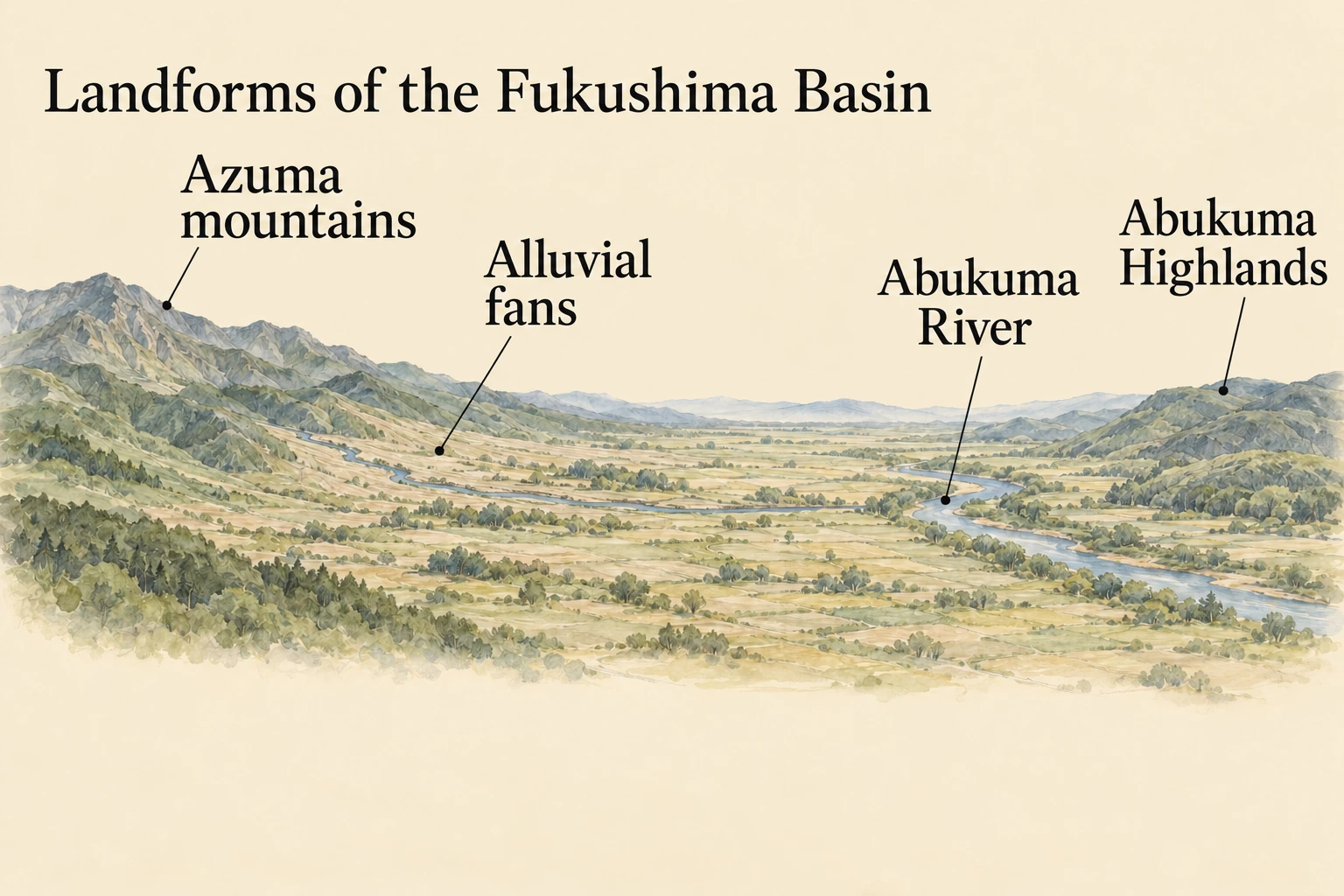
The Fukushima Basin lies between the Ou mountain system, including the Azuma range, to the west and the Abukuma Highlands to the east. The Abukuma runs north near the basin's eastern side. Rivers including the Arakawa, Matsukawa and Surikamigawa join from the west, forming fans at the mountain outlets.
Conversion from mulberry fields to orchards varied by place
In Koori, cultivation of peach varieties leading to today's production began around 1891. A decline in sericulture encouraged conversion from mulberry to fruit, said to have gathered pace around 1955. This is Koori's history, not evidence that the entire basin changed in one year.
The 1916 Fukushima-ken Chishi lists cocoons and raw silk among Shinobu District's main products while also describing pear and peach cultivation and shipments outside the prefecture. Sericulture and fruit growing already coexisted at this time.
From canning to fresh fruit
Koori's account describes substantial early production for canning, followed by growth in fresh fruit as storage and distribution techniques developed.
Cold after flowering changes the work
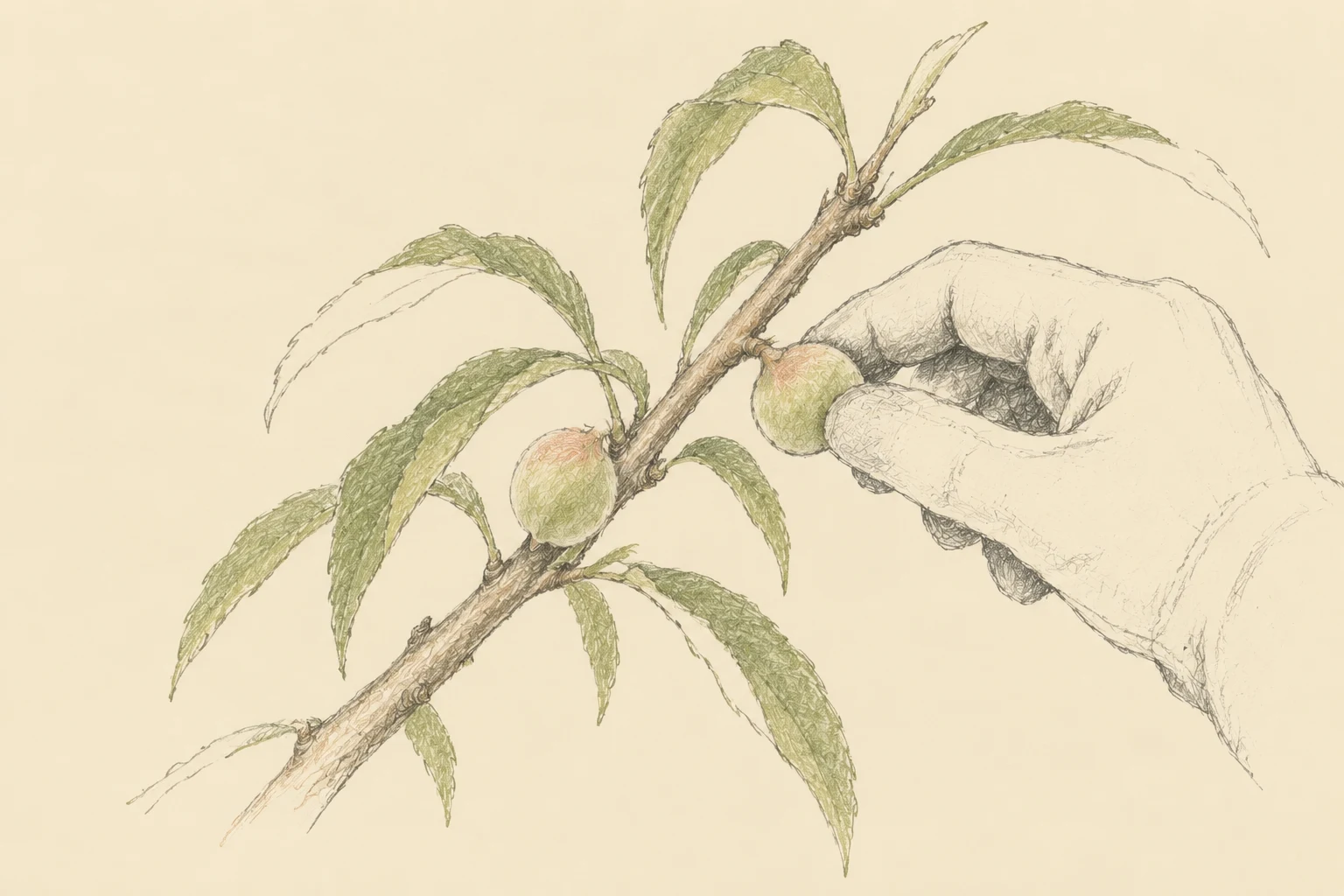
Freezing temperatures and frost in April 2021 damaged peach and pear flowers and young fruit. The prefectural fruit research institute recorded measures taken at a small number of orchards to secure a crop afterward.
After the damage in April 2021, growers at three peach orchards in the Date area delayed thinning until fruit set could be confirmed and retained fruit mainly on upper branches. Thinning removes some fruit to regulate the number remaining. At one surveyed pear orchard in Fukushima City, artificial pollination was repeated and decisions about retaining fruit were delayed.
Frost damage varies with minimum temperature and growth stage
Frost risk depends on more than the minimum temperature. The same temperature has different effects before buds develop, during flowering and after young fruit forms.
One approach to frost protection combines predicted growth stages with forecast minimum temperatures. Predictions based on observations at the fruit research institute in Iizaka, however, cannot necessarily be applied unchanged to another production area.
For blossom or harvest visits, check variety, location and that year's growth information.
References
- 福島県農業総合センター果樹研究所「防霜対策のための果樹の発育ステージ予測モデルの開発」2022年。https://www.pref.fukushima.lg.jp/uploaded/attachment/504198.pdf
- 福島県農業総合センター果樹研究所「果樹の凍霜害危険度推定シートを活用することで防霜対策を効果的に実施できる」2022年。https://www.pref.fukushima.lg.jp/uploaded/attachment/504199.pdf
- 福島県農業総合センター果樹研究所「令和3年4月の凍霜害によるモモの果実生産への影響」2022年。https://www.pref.fukushima.lg.jp/uploaded/attachment/504223.pdf
- 福島県農業総合センター果樹研究所「ニホンナシにおける令和3年4月の凍霜害の果実生産への影響」2022年。https://www.pref.fukushima.lg.jp/uploaded/attachment/504224.pdf
- 桑折町「桑折町の桃の歴史」2026年1月5日更新。https://www.town.koori.fukushima.jp/site/kooripeach/1077.html
- 国土交通省「5万分の1都道府県土地分類基本調査(福島県)」。https://nlftp.mlit.go.jp/kokjo/inspect/landclassification/land/5-1/prefecture07.html
- 福島県『福島県の市町村の歴史的形成過程』。https://www.pref.fukushima.lg.jp/uploaded/attachment/88025.pdf
- 田村俊和・石井英也・日野正輝編『日本の地誌4 東北』朝倉書店、2008年。ISBN 9784254167641. CiNii Books
- 丸井佳寿子・工藤雅樹・伊藤喜良・吉村仁作『福島県の歴史』第2版、山川出版社、2009年。ISBN 9784634320710. Bibliographic record
- 福島県教育会編『福島県地誌』六盟館、1916年。 NDL original. Relevant passages checked, p. 78; a regional account from 1916.