Hiroshima Oyster Farming: From Tidal-Flat Racks to Offshore Rafts
Introduction
Strings of oyster-bearing shells threaded onto wire hang beneath rafts on the sea. Young oysters and growing oysters are not necessarily raised in the same place. Oyster farming in Hiroshima uses different equipment at each growth stage, with monitoring of sea conditions.
1. Attaching larvae to shells
Cultivation begins with collecting oyster larvae drifting in the sea in summer on scallop shells. This uses their natural tendency to settle on hard surfaces to gather oysters for farming.
After collection comes a conditioning stage on tidal-flat racks. The racks emerge as the tide falls, reducing time underwater. Hatsukaichi City describes this as a way to make the young oysters more resistant to changes in their environment.
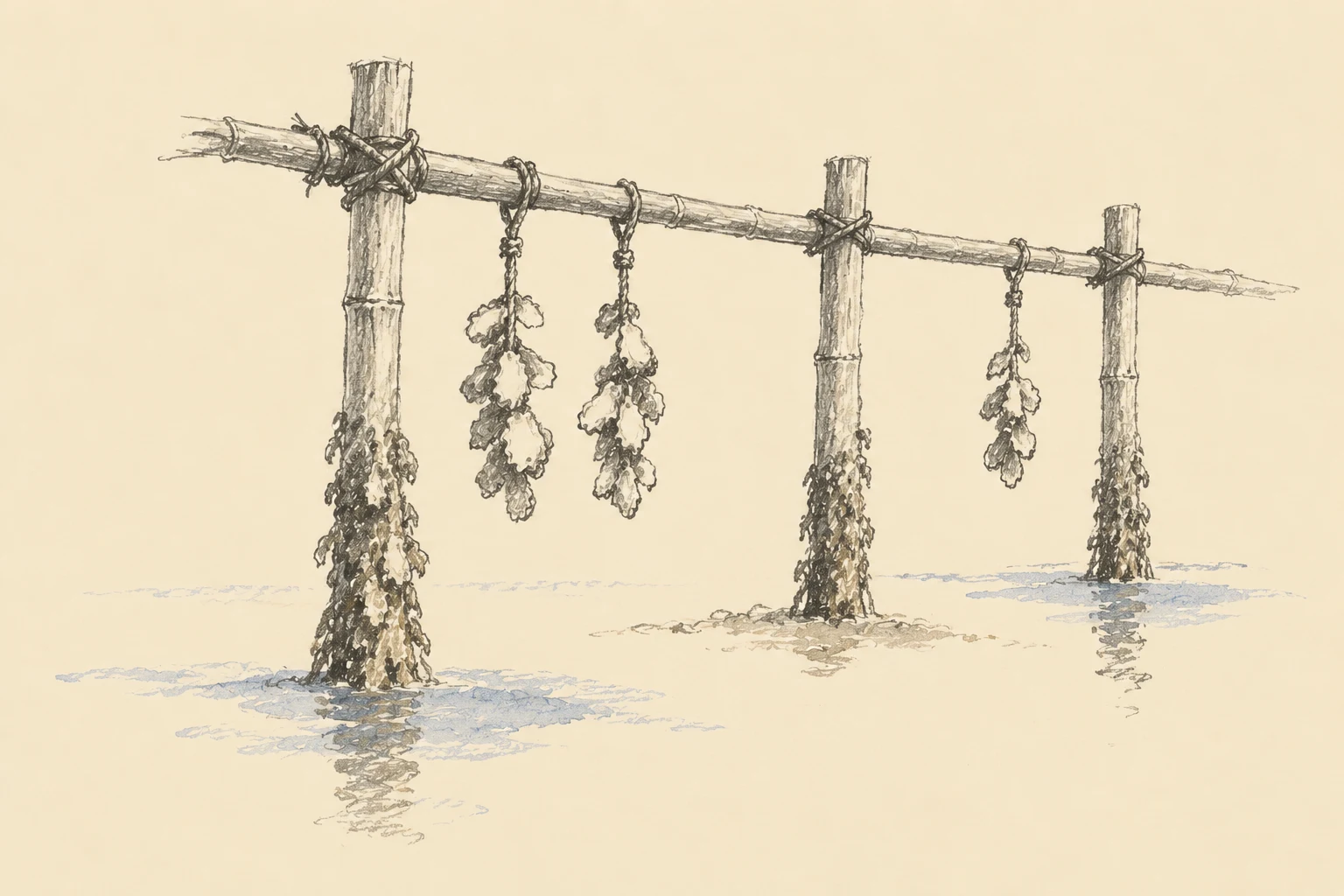
2. From tidal-flat racks to offshore rafts
Shells bearing conditioned oysters are restrung on wire and suspended from offshore rafts. The underwater strings form part of the farm just as much as the rectangular frame on the surface.
At harvest, boat cranes and other equipment lift the heavy strings. Cultivation requires collecting, moving, suspending and lifting the oysters.
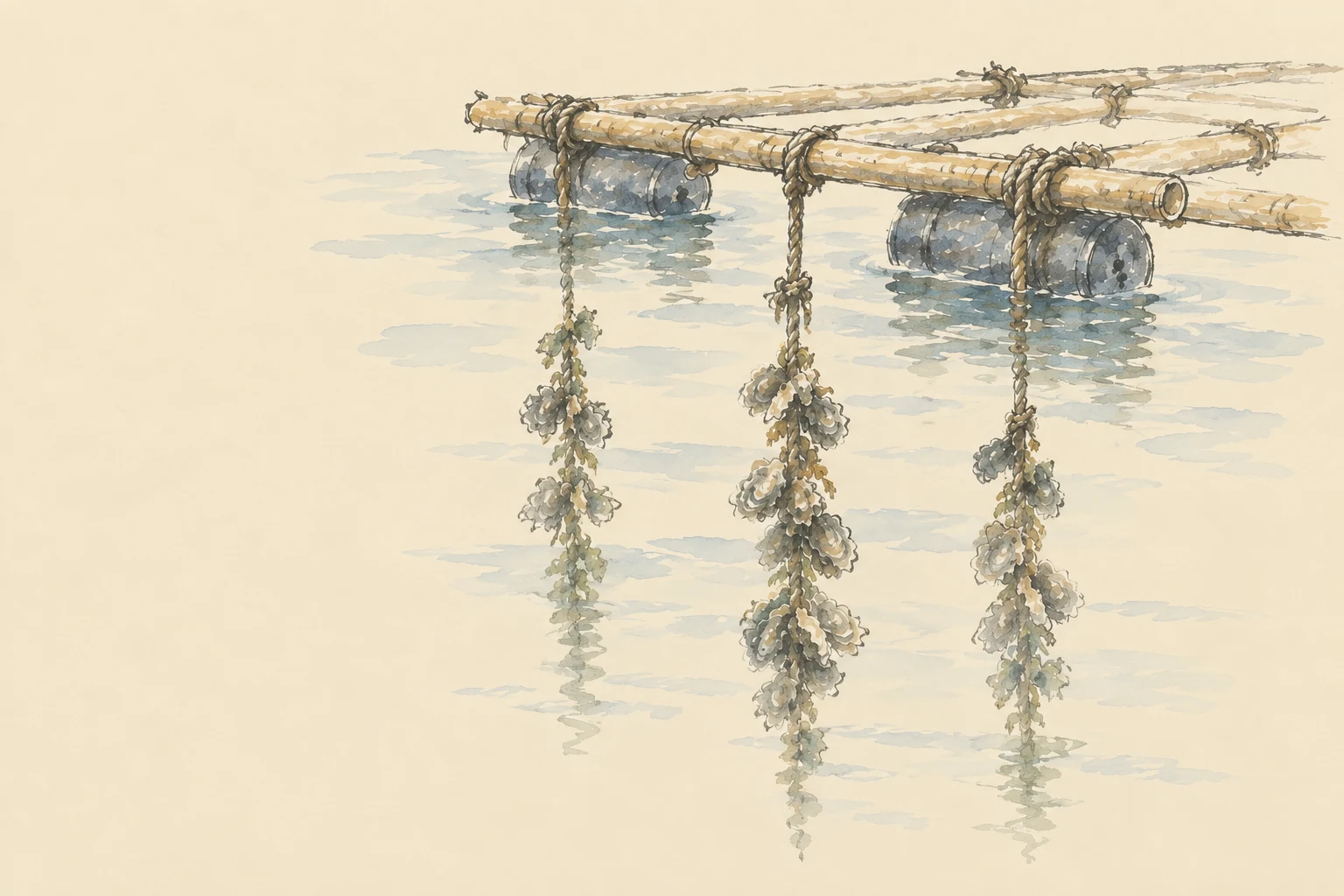
3. Measuring conditions invisible from the surface
Hiroshima City regularly measures bay water temperature, salinity and the amount of oxygen dissolved in the water for cultivation guidance. Chlorophyll fluorescence is also measured as an indicator of phytoplankton available as food.
Measurements come with a location, depth and date. Even within the same bay, when and at what depth a reading was taken affects what it can tell growers about their farm.
4. From farm to shipment
The 1977 prefectural history describes fresh shipment and processing, and also identifies disposal of oyster shells and washing water as problems. Harvesting therefore left work to be done on shore as well as at sea.
Food hygiene is separate from monitoring the growing environment. Hiroshima Prefecture inspects workplaces and, during the raw-consumption oyster harvest season, tests oysters and seawater by sea area.
Size or an impression of freshness cannot establish whether oysters can be eaten raw. Check whether the purchased product is labeled for raw consumption or for cooking.
The raft connects rearing on the tidal flats with processing and shipment ashore. Managing the growing water and managing oysters as food continue at their respective stages.
References
- 楠木豊『昭和時代の広島カキ養殖』楠木豊、2009年8月、463頁。NDL書誌 000010552440
- 広島県編『広島県史 地誌編』広島県、1977年3月。pp.353–369(牡蠣は365–366)。デジタル本文
- 森川洋・篠原重則・奥野隆史編『日本の地誌9 中国・四国』朝倉書店、2005年。ISBN 9784254167696。出版社書誌
- 廿日市市「冬の味覚 かき」養殖工程の解説。
- 広島市「広島かきの養殖指導等」。
- 広島県「広島かきの衛生対策」。