Nanyo's Citrus Orchards: Stone Walls, Harvest Workers and Cooperative Shipping
Introduction
Steep slopes in Nanyo, southwestern Ehime, facing the Uwa Sea support citrus orchards behind stone walls. Growing fruit requires maintaining stonework and windbreaks; harvest must then be carried down and graded. At Maana in Yawatahama, recruiting harvest workers has also meant finding rooms for them.
1. Harvest labor and places to stay
The 1967 study Kankitsu Saibai Chiiki no Kenkyu records workers arriving from Sadamisaki alongside labor supplied by local part-time farming and fishing households. Workers from outside the district were helping with harvests before the later recruitment scheme began.
In 2015, Mandarin opened in the converted former Shitada Elementary School. The city describes it as accommodation for citrus harvest workers and agricultural trainees. Facilities supporting fieldwork extend beyond the orchard.
2. Kari-hama's stonework and windbreaks
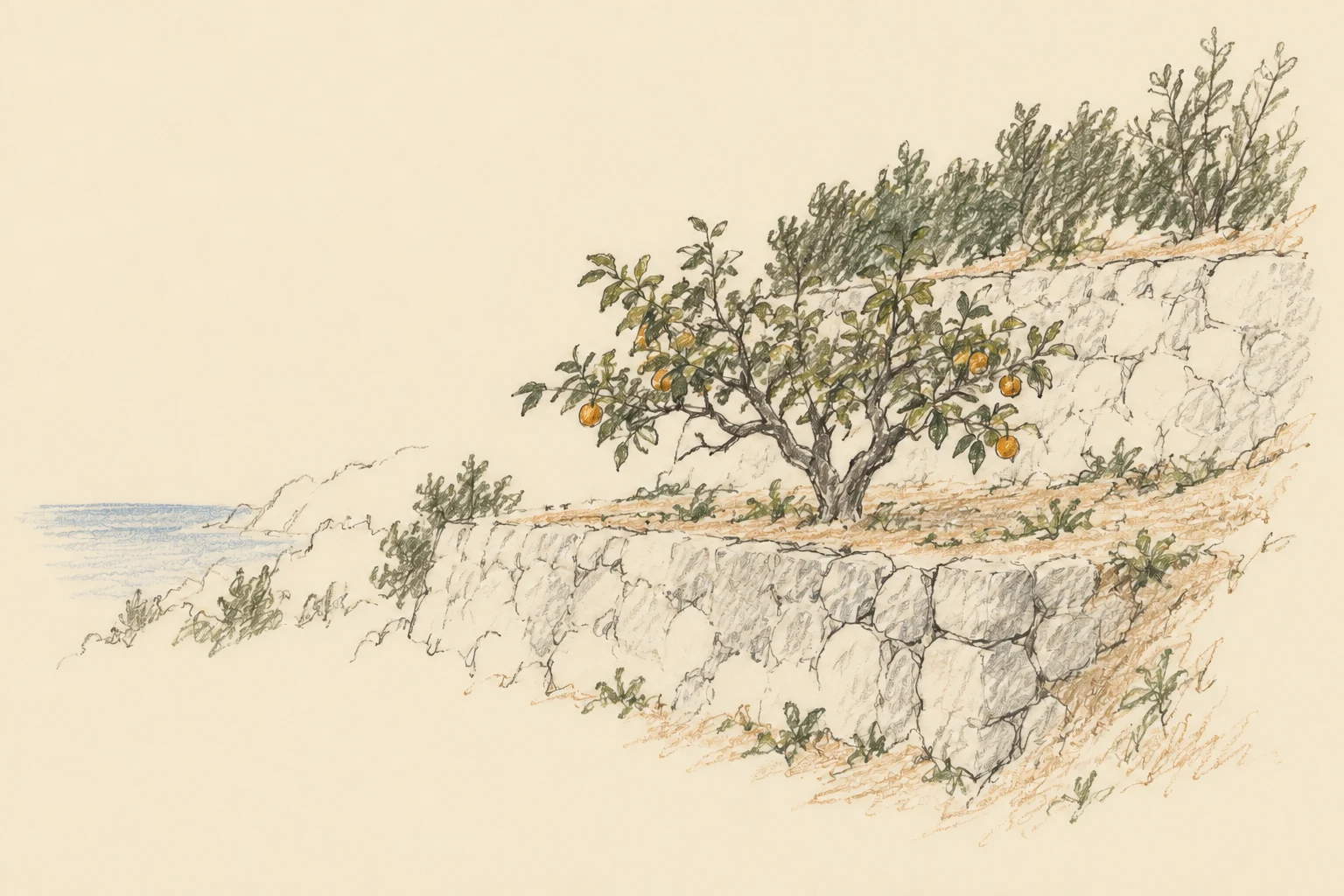
Limestone is widely used in Kari-hama's terraces. Communities along the Uwa Sea use nearby rock, so materials differ by district. Kari-hama's pale stonework reflects its local limestone.
Citrus expanded into fields formerly growing subsistence crops and mulberry. Stonework needs repairs after harvest, and training passes building skills to younger farmers.
Windbreaks protect against strong and salt-laden winds. Excess foliage can obstruct light and compete for nutrients, however. Management changes between spring and typhoon or winter seasons, adjusted to field orientation and varieties.
Direct sun, reflection from the sea, and reflection or radiant heat from stonework are sometimes called “three suns.” Quality also involves pruning branches, thinning fruit and selecting varieties; the phrase alone does not determine taste.
3. Changing varieties and carrying fruit out
The 1985 prefectural history describes Misaki on the Sadamisaki Peninsula converting from ordinary natsumikan to amanatsu and other varieties. Prices, consumption, cold and drought damage, and replanting support all played roles. Perennial trees cannot all be replaced at once when demand changes.
In Maana, roads and monorails accompanied orchard expansion and changed work. Fruit harvested on steep slopes needs a route to collection points. Varieties and transport have changed within a landscape retaining stone walls.
4. Cooperative grading aligns shipment standards
Kyosen, cooperative grading, can refer to shared sorting facilities and to producer organizations centered on them. These organizations also work on varieties, cultivation guidance, shipping and sales.
The 1986 prefectural history describes the replacement of wooden boxes with cardboard packaging and the construction of large collection and shipping facilities alongside the consolidation of grading plants. Large facilities also needed enough fruit to justify their operation. Changes in cooperative grading therefore involved reorganizing collection, packing and shipment to markets as well as installing new sorting machinery.
5. Work sustaining the slopes
Stone repair, picking, transport, grading and sales connect in Nanyo orchards. Additional harvest workers need rooms; changing varieties requires decisions about future farm operation.
Orchards are workplaces where maintaining a cultural landscape and shipping fruit overlap. Origin, variety and shipping-organization labels on the product also identify different stages between production on the slope and sale.
References
- 農林水産省「愛媛・南予の柑橘農業システム 地域概要書」。pp.21–24、30–31。
- 愛媛県史編さん委員会編『愛媛県史 地誌Ⅱ(南予)』愛媛県、1985年。窪田重治担当「八幡浜市と周辺のみかん」冒頭〜真穴・川上、「佐田岬半島の夏柑(夏みかん)栽培②」。
- 四国西予ジオパーク「宇和海狩浜の段畑の農漁村景観」。
- 農林水産省aff「愛媛・南予の柑橘農業システム」2024年2月、かりとりもさくの会。
- 愛媛県史編さん委員会編『愛媛県史 社会経済1 農林水産』愛媛県、1986年1月。pp.564–569、および公開本文「需給構造の変化と共販組織の大型化」「選果場統合近代化の実態」「過剰化と生産者の対応」等。NDL原本。
- 森川洋・篠原重則・奥野隆史編『日本の地誌9 中国・四国』朝倉書店、2005年。
- 村上節太郎『柑橘栽培地域の研究』第1集・第2集合本、愛媛出版協会、1967年7月。pp.442–443・445–456および著者自序。 デジタル本文
- 八幡浜市「みかんの里宿泊・合宿施設『マンダリン』について」。