Edo's Waterworks: Bringing Water into the City and Distributing It
Introduction
When Tokyo was known as Edo, water brought from beyond the built-up area sustained its growing population. The Kanda and Tamagawa systems combined intakes, channels to town and equipment for distribution. Connecting river and city required more than a channel: gradients had to be maintained, branches managed and damaged facilities repaired.
1. Letting water flow into town
Water was guided toward where it was needed using its tendency to flow downhill. Uncovered waterways, or open channels, followed the terrain and connected in town to distribution systems including underground conduits. Branches divided the flow along the way.
The Tamagawa system took water from the Tama River at Hamura and carried it about 43 kilometers through an open channel to Yotsuya-Okido. A fall of roughly 92 meters allowed water to flow along its route across the Musashino Upland. The Tokyo water bureau dates excavation to 1653 and the start of supply within Edo to 1654.
2. Dividing the flow through town
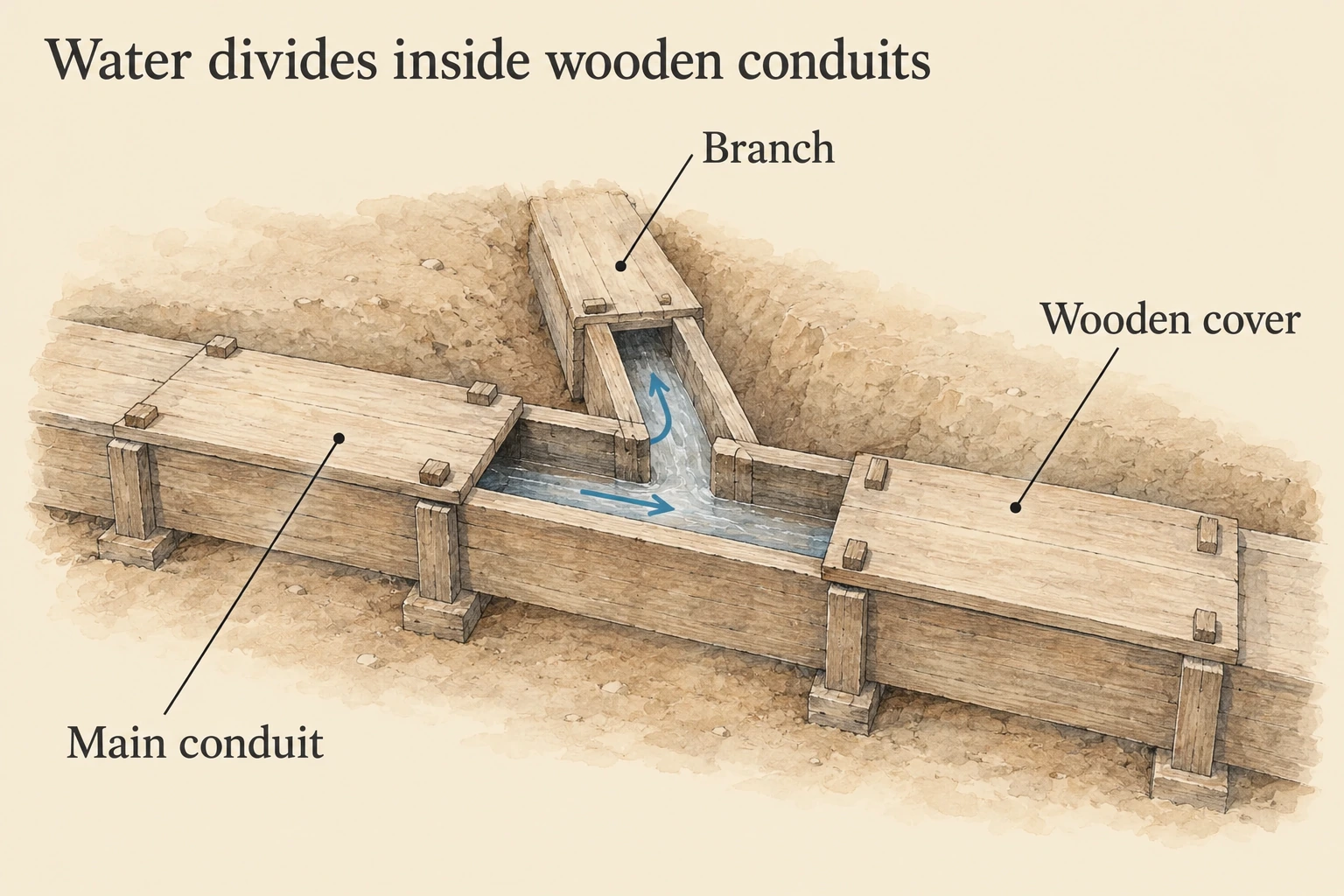
Wooden conduits and other distribution facilities divided and carried water within the city. These wooden waterways connected the open channels outside town with urban distribution.
The presence of a channel does not establish equal quantities at its farthest ends. Branches, conduit sizes and flows affected supply. An old distribution plan cannot uniformly reconstruct every household's water use.
3. Work continued after excavation
The introduction to the 1965 edition of the Josuiki describes inspecting channels and conduits for damage and submitting written reports among the duties of its compiler, Ishino Hiromichi. Water supply needed arrangements for checking and reporting the condition of facilities as well as the facilities themselves.
Channels could not simply remain in use unchanged after completion. Sediment obstructed flow; damage and leakage reduced delivery. Urban supply depended on repairs and management as well as initial construction.
4. What the Josuiki and surviving equipment show
The Josuiki was compiled in 1791. It was not a diary written during the original construction of the Kanda and Tamagawa systems, but a later account organizing their origins, structure and management.
Read alongside the Tokyo Waterworks Historical Museum's materials and wooden-conduit displays, it helps connect lines on a plan with physical materials and equipment.
Open channels visible today do not necessarily preserve Edo-period width, banks or flow along their entire length. Covered, relocated or altered sections, reconstructions and excavated objects are different forms of evidence.
An existing channel, an excavated wooden conduit and a display model represent different dates and subjects. Checking the labels helps distinguish surviving parts from later changes.
5. The city extended beyond its streets through water
Edo depended on water sources outside the built-up area. Channels carried that water along the terrain into the city, where it was distributed through facilities that required continuing repairs.
Modern water supply uses different facilities and conditions. Yet the separation between tap and source, and the continuing work of delivery, remain useful ways to understand city life.
References
- 東京都水道歴史館。本文
- 石野広通著・東京都水道局編『上水記』東京都水道局、1965年、71頁。1–9・67–69頁。NDL原本。
- 港区『港区史 通史編 近世(上)』2021年、103–112頁「江戸の上水道」「港区内の上水道」「発掘調査の事例」。103–106頁、106–107頁、108–112頁。
- 江戸遺跡研究会編『江戸の上水道と下水道』吉川弘文館、2011年10月、前付2頁・本文218頁・図版4頁。ISBN 9784642034494。 CiNii Books
- 貝塚爽平『東京の自然史』講談社〈講談社学術文庫2082〉、2011年。ISBN 9784062920827。 CiNii Books
- 菅野峰明・佐野充・谷内達編『日本の地誌5 首都圏I』朝倉書店、2009年。ISBN 9784254167658。 CiNii Books
- 東京都水道局「玉川上水の歴史」。本文。