Aizu's Snow and the Work of Keeping Roads Usable
Introduction
Snow amounts vary greatly across Aizu in winter. Even climate normals covering the same 30 years show a large difference in snow depth between Wakamatsu in the Aizuwakamatsu Basin and Tadami in Oku-Aizu.
To keep roads usable even in areas with heavy snow, snowplows push fresh snow aside and scrape away compacted snow, clearing a path for traffic.
Different snow amounts in Wakamatsu and Tadami
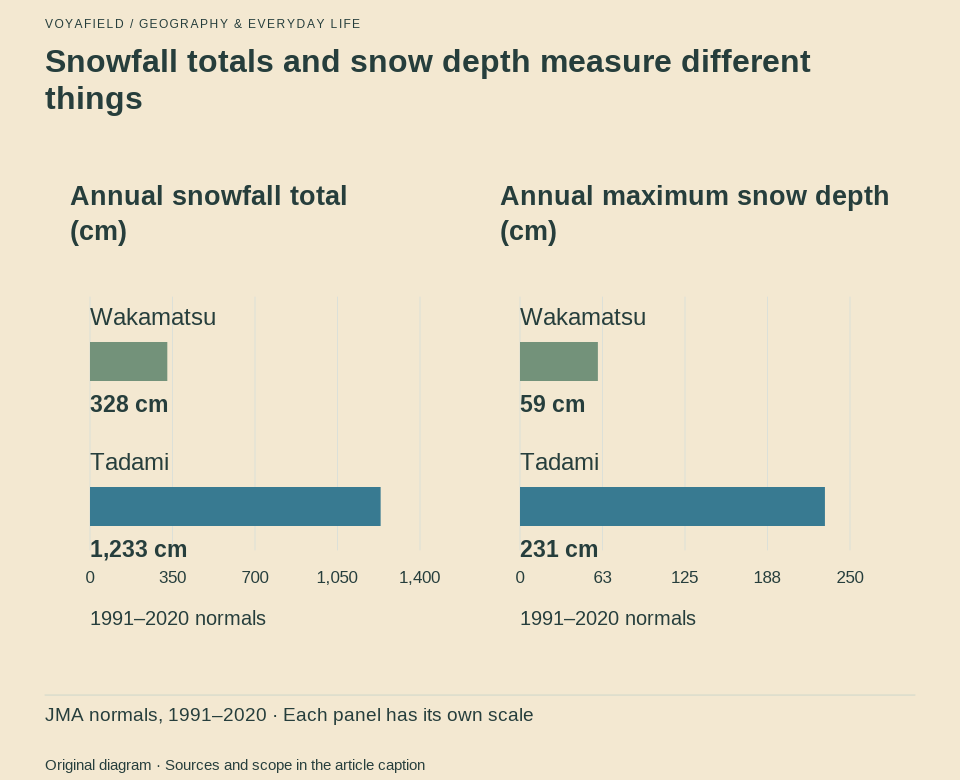
The Japan Meteorological Agency's 1991-2020 normals show an annual snowfall total of 328 centimeters and an annual maximum snow depth of 59 centimeters at Wakamatsu. Tadami's figures are 1,233 and 231 centimeters. Snow amounts differ this much within a single prefecture. For these normals, the depths of newly fallen snow are added for each year, then averaged over 30 years. The annual maximum snow depth is also averaged over the same 30 years, using the deepest snow cover recorded in each year.
Snow amounts differ greatly between Wakamatsu and Tadami, even though both are in Aizu.
Machines do different work as snow conditions change
According to the Aizuwakamatsu national road office, its clearance area covers 91.8 kilometers: the usual 77.3 kilometers plus 14.5 kilometers assigned in winter. Three clearance stations, at Inawashiro, Aizuwakamatsu and Nishiaizu, cover them. This is one national office's network, not all roads in Aizu.
Fresh snow is pushed to the shoulder; compacted snow and ruts are scraped. When roadside snow narrows the carriageway, widening or removal becomes necessary. Work also includes removing overhanging snow, known as snow cornices, at tunnel entrances and preventing ice formation. Snowplow trucks, graders, rotary snow blowers and de-icing spreaders are used for their respective tasks.
Continued snowfall means repeated work on the same section. Available vehicles, operators and priorities affect how much can be covered.
Aizuwakamatsu's fiscal 2026 policy statement reported that, following the heavy snow of February 2025, the city had revised dispatch criteria, added snow-clearance vehicles and assigned teams to prioritize the removal of snow piles at major intersections during fiscal 2025.
Snow can remain at the door after the road is cleared
Fukushima's Kitakata Construction Office identifies 313.8 kilometers of carriageway and 87.0 kilometers of sidewalk for clearance. It also asks people not to park on roads or put household snow onto them.
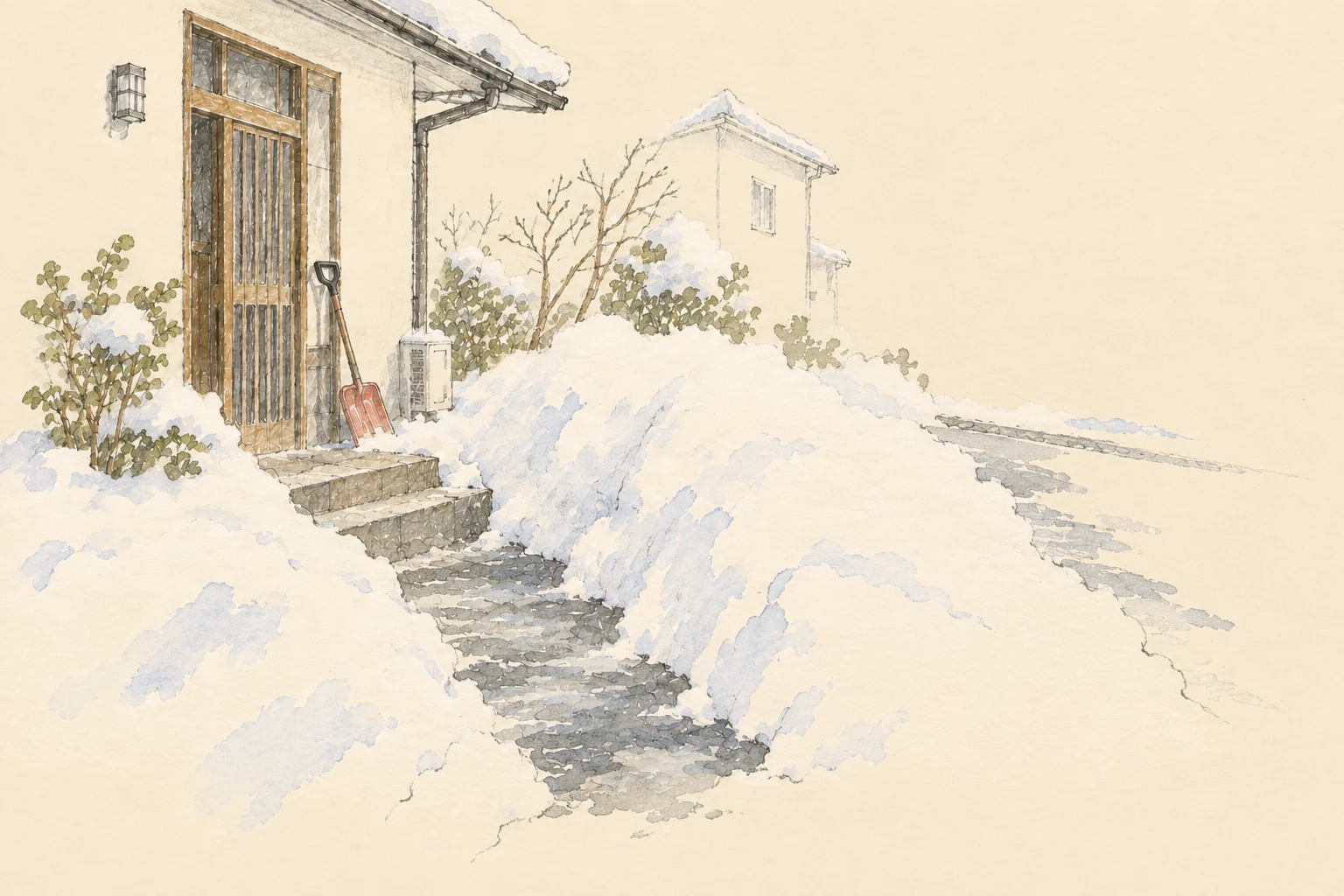
Snow pushed to the shoulder may remain in front of a door or garage. The Kitakata Construction Office asks residents to clear this snow themselves. Health, household composition and working hours can make this difficult.
Check winter conditions for the actual destination
Central Aizuwakamatsu, Inawashiro, Tadami and Minamiaizu differ in snow amounts and in the roads and transport services used to reach them. Use normals to understand broad patterns, then check forecasts, road restrictions and rail and bus operations before departure.
References
- 気象庁「平年値(年・月ごとの値) 若松(福島県)」。https://www.data.jma.go.jp/stats/etrn/view/nml_sfc_ym.php?block_no=47570&prec_no=36
- 気象庁「平年値(年・月ごとの値) 只見(福島県)」。https://www.data.jma.go.jp/stats/etrn/view/nml_amd_ym.php?prec_no=36&block_no=0297&year=&month=&day=&view=
- 国土交通省東北地方整備局郡山国道事務所「会津地区の除雪」。https://www.thr.mlit.go.jp/koriyama/koriyama/aizu/business/snow/index.html
- 福島県喜多方建設事務所「除雪作業」2025年9月11日更新。https://www.pref.fukushima.lg.jp/sec/41350a/josetsu.html
- 会津若松市「令和8年度施政方針」2026年2月26日更新。https://www.city.aizuwakamatsu.fukushima.jp/docs/2023021500012/
- 田村俊和・石井英也・日野正輝編『日本の地誌4 東北』朝倉書店、2008年。ISBN 9784254167641. CiNii Books
- 丸井佳寿子・工藤雅樹・伊藤喜良・吉村仁作『福島県の歴史』第2版、山川出版社、2009年。ISBN 9784634320710. Bibliographic record
- 佐瀬与次右衛門・佐瀬林右衛門著『日本農書全集 第20巻 会津歌農書・幕内農業記』農山漁村文化協会、1982年。ISBN 9784540820021. Bookseller's bibliographic record